Running Wild Road
Notes from beside dad lore
My dad taught me how to tell stories.
Not intentionally.
He never sat me down and said, “Scampi Rat, this is how you tell a story.”
I watched him.
Dad can hold a room. He does voices. He becomes the characters. His face changes. His body changes. He moves around. He knows exactly when to pause and when to let you think you know where the story is going before taking it somewhere else entirely.
He's funny as hell.
And he has material.
So much material.
Some of it happened to him. Some of it happened to people he knew. Some of it was told to him by his uncles, who had heard it from somebody else. Some of it is local history. Some of it is family history. Some of it has been repeated for so long that fact and folklore have probably traded clothes a few times.
Dad Lore from the legend Otha Bodie himself.
I grew up on it.
I also grew up in the woods.
Dad knows the land like the back of his hand. I grew up riding horses and four-wheelers down dirt roads, through woods and across the places he had hunted, worked and wandered his entire life.
He taught me how to walk quietly enough to sneak up on wildlife. He taught me to listen to squirrels.
They'll tell on you.
One starts fussing because it sees you, and suddenly the woods know you're there.
Dad can gobble well enough to make a turkey answer him and to win any calling competition he ever entered. He can hoot like an owl and get an answer back. When we were separated in the woods, he would hoot.
I knew that sound.
Go toward Dad.
I learned to whistle and mimic birds too. Nobody ever announced that these things were lessons. They were simply how we moved through the world.
Dad taught me that the woods were never quiet. You just had to learn how to listen.
I think he taught me the same thing about stories.
A road wasn't necessarily just a road. A curve could have a dead man underneath it. A patch of woods could be hiding a cemetery. An old house could contain something so strange that if you put it in a novel, somebody would accuse you of being unrealistic.
And then there was Running Wild Road.
I grew up running wild on Running Wild.
Barefoot. Five years old. On a four-wheeler or a horse. Sometimes with Dad. Sometimes with my cousin Clint, who was seven years older than me.
Sometimes by myself.
And I never really stopped.
Running Wild followed me through childhood and into my teenage years. Horses. Four-wheelers. Dad's truck. The loopty-loops, a stretch of hills in the dirt road that people drove too fast because going over them felt like a roller coaster.
Even now, when I go home, Ali will sometimes say, “Let's go ride the loopty-loops. Let's go to Running Wild.”
So we do.
Running Wild Road isn't somewhere I used to go.
It's one of those places that has remained a fixed point in my life. I know it as geography. I know it as memory. And I know it through the stories Dad layered over it until I couldn't really separate the road I traveled from the things I knew had happened there.
There was always another version of Running Wild Road underneath the one I could see.
That one was full of stories.
One of them was waiting for me in the woods.
Watching You Die
I was probably thirteen or fourteen when Miss Hall gave us an assignment to find an interesting epitaph and make a grave rubbing.
I told Dad. I half thought it was a mad idea for an assignment. I had never paid much attention to graves or what people wrote on them.
But Dad had.
Of course he had.
Dad drove me down Running Wild Road, pulled off, and walked me into the woods. There was an old abandoned cemetery back there, almost completely reclaimed by nature.
Dad didn't need directions. He knew exactly where it was because he'd spent his life on that land, hunting, working and walking through places most people only drove past.
Somewhere among those graves was the one he'd brought me to see.
Dad doesn't remember the exact epitaph now. He remembers the sentiment being something roughly along the lines of: once I stood where you are, looking at a grave and thinking I would never end up in one. Now I'm lying here, watching you die.
Which is a wild thing to leave on your gravestone.
Apparently, Dad wasn't satisfied with finding me one good grave rubbing. That same day, we went looking for two more: memorials for William Barret Travis and James Bonham, both heroes of the Alamo.
I took all three rubbings to school.
Miss Hall looked at what I'd brought back and essentially told me it was pretty unfair that I hadn't just found the best one.
I'd found the best three.
She gave me fifteen extra points on my final exam and apologized that she couldn't give me any more extra credit.
One of my friends had a different complaint.
“You should have gave me one of those.”
Fair.
More than two decades later, Dad and I were reminiscing about that day. I asked him about the grave on Running Wild Road and whether he remembered what it said.
He couldn't remember the exact words anymore, but he remembered the grave. And he remembered exactly where the cemetery was.
Of course he did.
Dad said he'd go back over there, find it and send me a picture.
So today, he did.
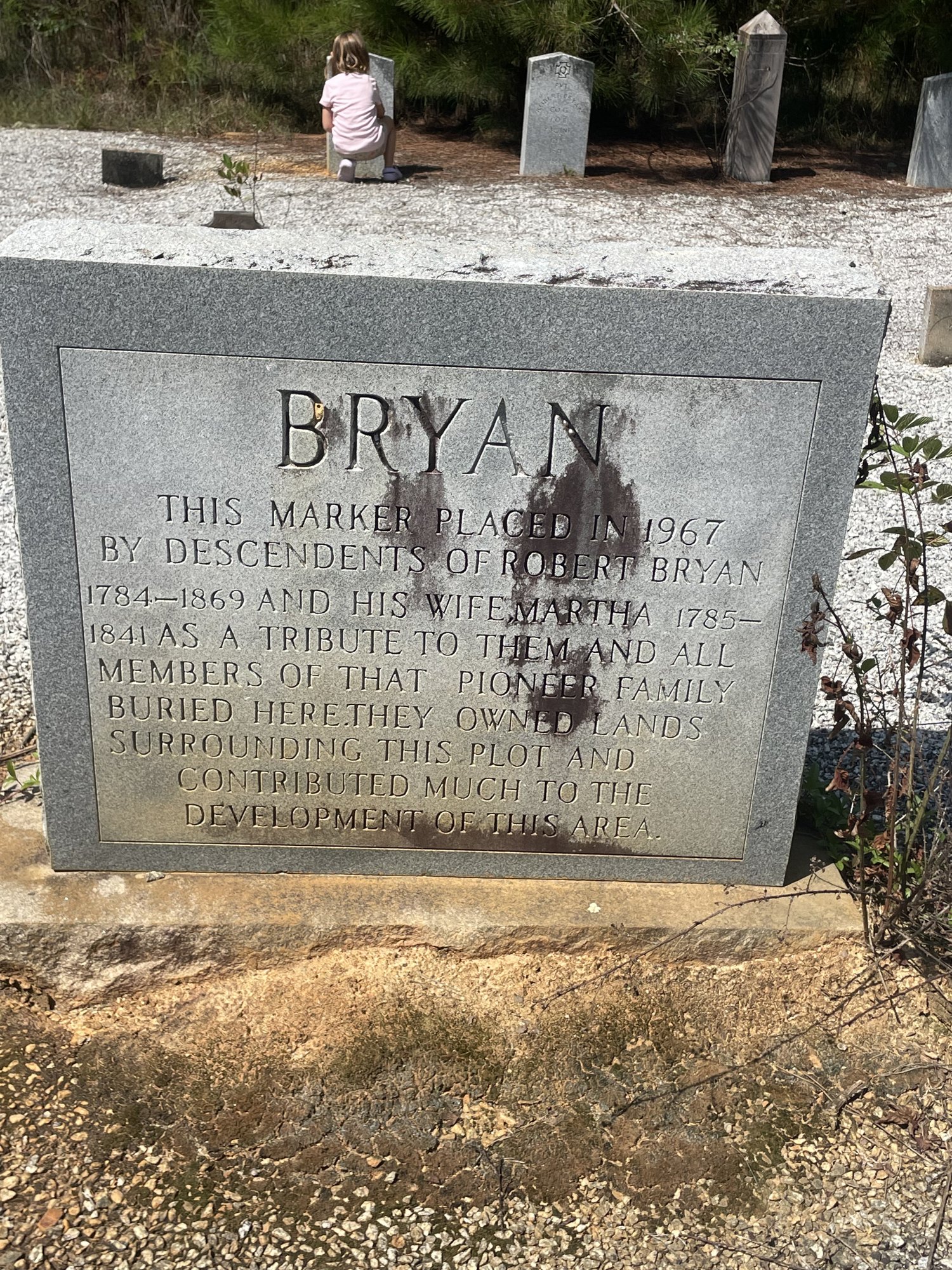
Except when he got there, the cemetery wasn't quite the place either of us remembered. Someone had been caring for it. What I remembered as an abandoned little graveyard being reclaimed by the woods had been cleaned up. There were newer markers now, including one placed by descendants of the Bryan family whose land once surrounded the burial ground.
Some of the old stones were still there.
Dad couldn't find mine.
Not yet.
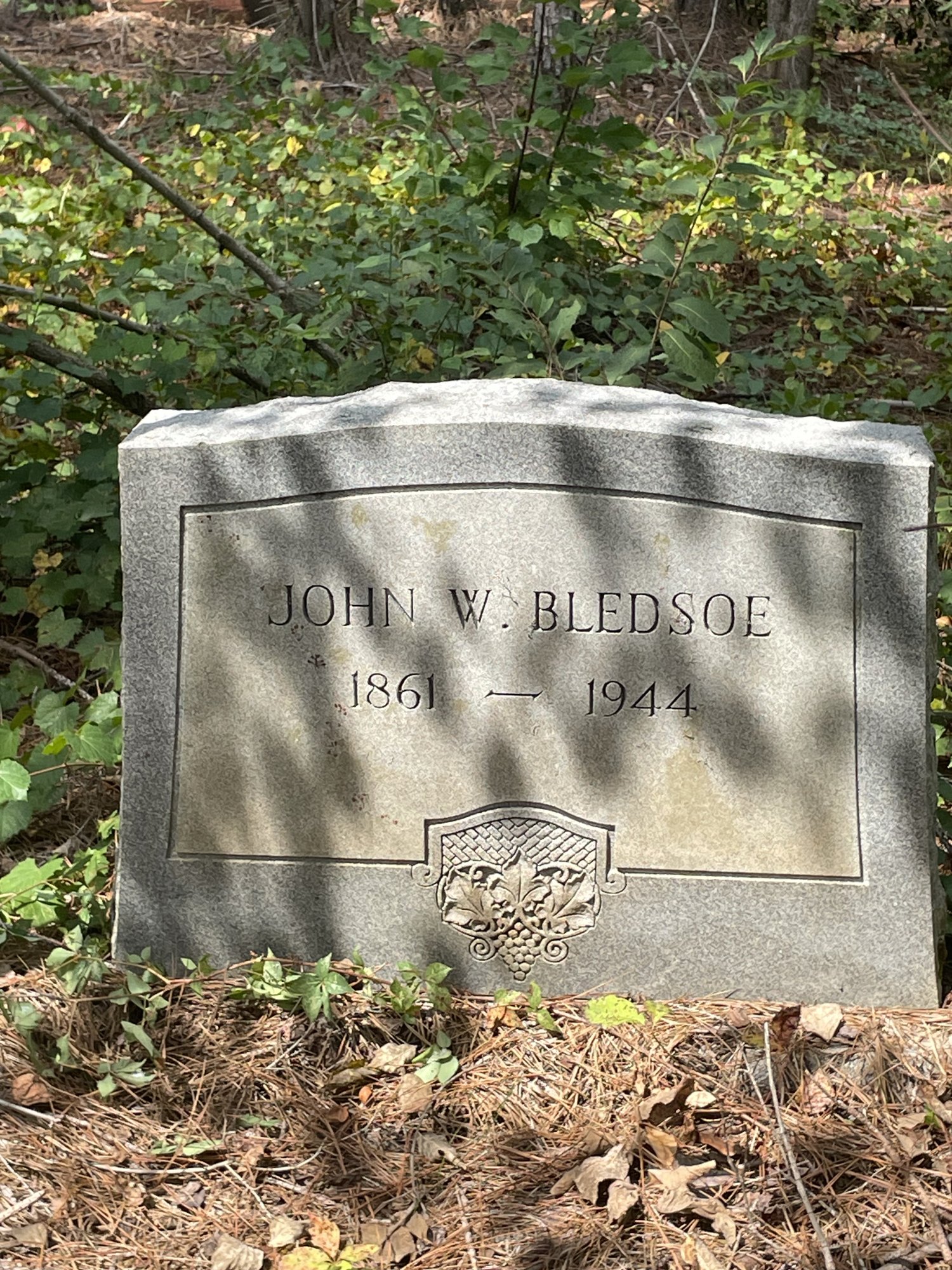
He sent me pictures of the cemetery instead.
I immediately asked why he hadn't photographed every old stone he couldn't read.
Apparently, some things require supervision.
So when I go home, we're going back together. More than two decades after Dad first walked me into those woods looking for a grave, we're going to do it again.
This time, I'm bringing a camera.
The Headless Horseman
The cemetery wasn't the only story hiding on Running Wild Road.
Just past the place where Dad would turn off toward the graves, there is a curve.
A man died there.
The story Dad grew up hearing was that the man had been working with some kind of pipe, possibly laying water lines. He was carrying or maneuvering it around his neck when the pipe contacted an overhead power line.
The electrical injury killed him catastrophically. In the story passed down locally, it decapitated him.
A terrible accident became something else.
When Dad was a little boy, his uncles told him the dead man was the Headless Horseman.
And that he might come get him.
Dad grew up.
Had children.
And naturally passed this extremely useful information along.
So my siblings and I grew up riding four-wheelers and horses along Running Wild Road knowing that somewhere around that curve was a Headless Horseman who, according to family sources, remained potentially active.
That's how folklore survives, I suppose.
A man dies. A story grows around him. An uncle scares a little boy. The little boy grows up and scares his children.
And everybody remembers the curve.
The Sprout Sisters
The Sprout Sisters lived nearby, just off Running Wild Road in that same little web of roads around Fruit Hill. The first home I ever lived in was on that road. Dad still lives nearby.
This story is different.
Dad didn't inherit it.
He was there.
He was working for my maternal grandfather, James Henry, whom everyone called Boss Man.
The Sprout Sisters were two elderly women. Dad remembers one being in her mid-nineties and the other, who had special needs, being in her late eighties. They were living together in an old deteriorating house on property Boss Man or one of his buddies was involved with.
The plan wasn't to throw them out. They were going to be allowed to remain there. Maybe the men could help fix the place up.
Then they went inside.
Snakes.
Everywhere.
Dad remembers them in the mattresses. In the couches. Across the surfaces of the house. The snakes hissed at the men. Some coiled defensively and tried to strike.
But they didn't bother the sisters.
The women had apparently been living among them for a very long time.
The men were horrified.
They helped get the sisters into nursing care where they could be properly looked after. Dad remembers some of the men involved helping cover their care while everything was sorted out.
And then they burned the house.
Because what exactly are you supposed to do with a dilapidated house full of snakes?
If Dad hadn't been standing there with a handful of other men as witnesses, people would probably assume the story was made up. After all, it sounds exactly like something that surely grew in the telling.
Two ancient sisters living peacefully in a ruined house filled with poisonous snakes. Strangers enter. The snakes turn on the strangers but leave the women alone. The sisters are carried away. The house burns.
Put that in a Southern Gothic novel and somebody will tell you the symbolism is a little heavy-handed.
Maybe that's why I have never understood the line between folklore and ordinary life quite the way I was supposed to.
Where I grew up, the Headless Horseman started with a man who actually died. The old women living peacefully among snakes weren't something Dad heard around a fire.
He walked into the house.
And when my teacher asked me to find an interesting epitaph, Dad didn't open a book.
He drove me down Running Wild Road.
I think a lot about where stories come from now.
Objects. Places. People. Words. History. Questions.
But some of mine were being handed to me long before I knew I was collecting them.
Dad taught me that the woods were full of information if I learned how to listen. A squirrel could tell me something was coming. A turkey could answer. An owl call could mean come home.
He taught me stories the same way.
Not with a lesson.
By telling them.
By making the dead man on the curve live again every time we passed him. By knowing there was a cemetery in woods where I saw only trees. By telling me about two old women who lived among snakes and then saying, when I inevitably wondered whether that could possibly be true:
“I was there. Ask so-and-so.”
Maybe that's why I still wander through the world assuming there is another story underneath the one I can see.
Maybe that's why I can't walk past an old house without wondering who lived there. Why I pick up objects in antique stores and want to know who held them first. Why I travel somewhere and start pulling at the history until something comes loose.
Maybe that's part of why I write.
I grew up thinking Dad was teaching me the land.
How to hear it. How to move through it. How to find my way home.
I didn't realize he was teaching me something else.
How to notice.
How to listen.
How to remember.
How to tell it.
And now, more than two decades later, we're going back into the woods looking for words someone left on a stone long before either of us got there.
Maybe we'll find them.
Maybe we won't.
But Dad still remembers enough of them to tell me the story.
And I remember enough to go looking.
Maybe that's another reason we tell stories.
Sometimes the stone disappears first.
I grew up running wild on Running Wild.
I still am.
Apparently, we're not finished yet.