Did Edgar Allan Poe Use AI?
Notes from beside the em dash
No.
Obviously not.
The man died in 1849.
I imagine Edgar Allan Poe would shoot me a sharp stare and regard the question as evidence that I was radically deficient in intellect.
Fair.
But I have evidence.
I saw it at the Poe Museum in Richmond, behind glass.
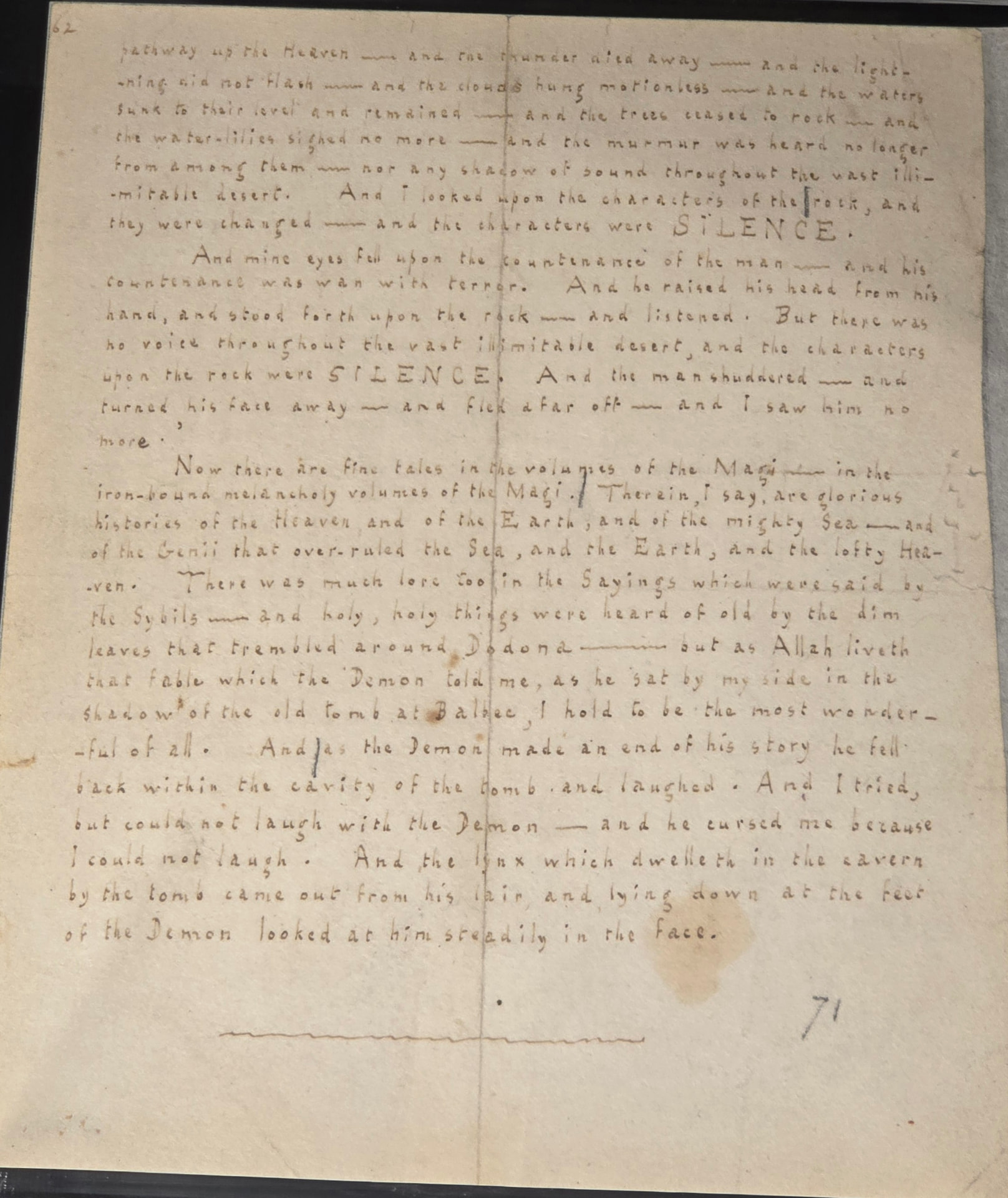
The manuscript is an early version of Silence: A Fable, written around 1832, when Poe was about twenty-three years old. His handwriting is tiny, meticulous, unnervingly regular. So much so that the museum has apparently learned to anticipate disbelief. The placard answers before anyone can ask:
“No, this document is not typed.”
Here's the better part.
It looks that way on purpose.
Poe deliberately wrote the manuscript in an extraordinarily small print hand to imitate the appearance of a typeset page. A human hand pretending, rather convincingly, to be a machine.
Interesting.
Because I've been writing a novel narrated by an artificial intelligence, and as part of that process, I sometimes deliberately make the prose sound like AI.
Not because AI wrote it.
Because I did.
The effect is part of the story.
Poe used his hand to make writing look typeset.
I use mine to make writing sound artificially intelligent.
Neither illusion removes the author.
If I do my job well enough, parts of that novel may someday be accused of sounding exactly like what I deliberately made them sound like.
That would prove the effect.
Not the authorship.
But Poe has another problem.
His manuscript is full of dashes.
So many dashes.
And in 2026, people have developed a fascinating new method of literary analysis:
Em dash — AI.
Case closed.
Except I'm standing in front of one written in ink almost two hundred years ago.
The mark isn't enough.
You have to read the work. Pay attention to the voice, the choices, the thought, what the writer is actually doing.
Poe would appreciate that.
Sixteen years after the manuscript I saw in Richmond, he published an installment of Marginalia and started complaining about punctuation.
And Edgar, I am listening.Yes.Exactly.Keep going.
“That punctuation is important all agree,” he begins, before arguing that almost nobody seems to understand just how important it is. Bad punctuation, he says, can leave a sentence perfectly intelligible while depriving it of half its “force,” its “spirit,” its “point.”
Point.
Poe apparently wasn't finished with that word.
In the same discussion, he says that, if no one “anticipated” him, he intended to write a magazine paper called The Philosophy of Point.
Edgar.I really wish you had.
As far as I can find, he never did. Or, at least, it never reached us.
Did someone beat him to it, as he apparently thought they might? Did he change his mind? Did another thought get there first?
Or did time?
Poe died the following year.
I don't know.
I only know I wish he'd written it.
But he left enough of the thought here for me to follow it.
Keep going.
Poe does.
He turns from the importance of punctuation to what happens when someone changes it.
He complained that writers were being “mortified and vexed” because printers would take the dashes authors had deliberately written in their manuscripts and replace them with commas and semicolons.
They thought they were correcting them.
Poe called it distortion.
Edgar, I know. I get it.Matter of fact, hand me the pen.
Because punctuation is not something sprinkled over finished prose like seasoning.
It is prose.
A word can carry two meanings at once. A deliberate misspelling can carry a third. Italics can put pressure on one word and quietly change everything around it. A line break can make the reader wait. A comma gives breath. A period closes something. Repetition can create rhythm. Alliteration can make language move differently in the mouth.
Sometimes the pause is the point.
Change those things and you may preserve the information. You have not necessarily preserved the intention.
If I spell something incorrectly on purpose and an editor corrects it, the corrected version is wrong. If I choose a word because it contains a double entendre and someone replaces it with a cleaner synonym, they may have removed half of what I wrote. If I italicize something, break a line somewhere, repeat a sound, withhold a comma, or put a dash in one exact place because I need the reader to hesitate there, those aren't scraps left behind after the writing.
They are the writing.
An editor can absolutely catch something I missed.
But an editor can also miss something I caught.
Apparently Poe and I would get along just fine.
Although perhaps not on handwriting.
Poe has something to say about that too.
All right, Edgar. Your pen.
Elsewhere in Marginalia, Poe says he is “far more than half serious” in believing that a person's “mental qualities” impress themselves upon a handwritten manuscript. He isn't talking merely about the words. He means the physical marks made by the hand.
He thought he could look at a person's handwriting and learn something about the mind that produced it.
Then, because this is Poe, he starts judging people's handwriting.
He takes particular aim at the fashionable hand of the dandy, the affected style of penmanship adopted because it was the fashion of the day. His ridicule eventually expands to practically every fashionable fool holding a pen.
Okay, Edgar.Give me the pen back, and don't judge my handwriting because mine is atrocious.Completely illegible, actually.
It has always been terrible. In second grade, I voluntarily stayed inside during recess trying to improve it. I wanted straight A's, handwriting was threatening the enterprise, and apparently eight-year-old me decided recreation was expendable.
It didn't work.
So I'm not entirely sure what Edgar Allan Poe would deduce about my “mental qualities” from a page of my handwriting, but I would like an opportunity to appeal whatever conclusion he reached.
I am, however, safe from his accusation of being a dandy.
No one has ever looked at my handwriting and thought, How fashionably affected.
Mostly they think, What the hell does that say?
For this reason, among others, I am grateful for the computer.
But there is something underneath Poe's argument that I can't leave alone.
If he was right that handwriting contains information about the person who made it, then something happened when we stopped making those physical marks ourselves.
Not to the writer.
To what we can see of the writer.
The typewriter didn't remove the human. It made my terrible A and Poe's meticulous A identical. The machine gave us both the same letter.
The computer carried that abstraction further. I no longer have to strike a key hard enough to impress a letter onto paper. The phone put the keyboard beneath my thumbs.
And now talk-to-text lets me compose an entire paragraph without forming a single letter.
Allegedly.
Talk-to-text and my Southern accent remain locked in a longstanding disagreement over what, exactly, I said.
Poe had to edit his printers.
I have to edit my phone.
Apparently every generation gets an intermediary to argue with.
But I am still writing.
That matters.
The thought is mine. The word is mine. The double meaning is mine. The rhythm is mine. The decision to stop here instead of there is mine.
Technology did not remove the writer.
It removed some of the visible evidence of the writer's hand.
With every technological step, the hand recedes a little farther from the page.
The human doesn't.
So where does the human go when the handwriting disappears?
Maybe into the choices.
Maybe that's where the human was all along.
Poe's handwriting might tell him something about Poe.
Mine might tell him that I should have enjoyed recess.
But the marks he chose tell me something different.
Which brings me right back to the dash.
The dash had acquired a bad reputation in Poe's time because writers had overused it.
All right, Edgar.Your pen.
“The Byronic poets were all dash,” he complains.
He singles out John Neal for having exaggerated its use into “the grossest abuse.”
So let's be clear.
Poe was not standing on a table screaming:
MORE DASHES.
He disliked indiscriminate punctuation too.
His point was considerably more sharp:
When I put one there, I fucking mean it.
Okay, he didn't say the fucking part.
I'm picking up his pen now.
But that's the argument.
All right. Keep writing, Edgar.
Because Poe goes on to explain exactly what his dash does.
It represents:
“a second thought — an emendation.”
Edgar.I love what you did there.
He doesn't merely define the dash. He uses one to demonstrate the definition.
A second thought — an emendation.
He writes the first thought. Then another arrives that makes the first more precise.
He doesn't erase the original. It wasn't wrong. It simply wasn't everything.
So he leaves it there.
The dash holds the two thoughts together. It preserves the instant in which one thought becomes more exact without pretending the first thought never existed.
The dash lets the reader see the thought becoming itself.
That is one of my favorite things I've found in Poe's writing about writing.
Because yes.
Punctuation can preserve the movement of a mind.
Poe explains that the dash can essentially mean or, to make my meaning more distinct.
Then he concludes:
“Therefore, the dash cannot be dispensed with.”
Okay, Edgar.Give me the pen back.Because you are going to be so pissed when I tell you what happened next.
We didn't dispense with it.
We put it on the keyboard.
And then artificial intelligence came along and somehow stole it anyway.
Not literally.
The dash still works —
see?
But AI-generated prose developed a reputation for using em dashes frequently. People noticed. Then people started treating the em dash itself as an AI tell.
And now human writers are removing intentional em dashes from their own writing because they're afraid someone will think a machine wrote it.
In Poe's time, writers had overused the dash. The dash acquired a reputation. Fashion turned against it. Printers began removing or replacing intentional dashes.
Poe got pissed.
Then time passed.
The panic faded. The dash survived. We kept using it. Eventually we mostly forgot there had ever been a fight about the damn thing.
And then artificial intelligence showed up.
AI overuses the dash. The dash acquires a reputation. Fashion turns against it again.
And now we're trying to tame the same little line all over again.
Except this time, the printer doesn't even have to take it from us.
We remove it ourselves.
Before the editor.
Before the critic.
Before anyone can point at it and say AI.
Edgar.They fucking did it again.
Same little line.
Same little panic.
New century.
New machine.
And this is where the handwriting question becomes even stranger.
We spent centuries moving the human hand farther from the page without necessarily moving the human out of the writing. Now a machine can imitate some of the evidence we left behind: vocabulary, syntax, rhythm, punctuation.
So we have started examining finished prose for proof that a human was ever there.
Was it the vocabulary?
The imperfections?
The rhythm?
The punctuation?
The em dash?
Artificial intelligence complicates the question of authorship. It can imitate choices. That is genuinely interesting.
But imitation is not intention.
An em dash can appear in two identical sentences for entirely different reasons. One may have been statistically predicted. One may have been deliberately chosen.
From the finished page, that difference may be difficult to see.
Which makes reducing the entire question of authorship to the presence of the mark even more absurd.
Poe never asked the dash to tell us who wrote the thought.
He asked it to tell us how the thought moved.
And I think we're asking an awful lot of one little horizontal line.
Which raises another question.
Why does AI like the dash so much anyway?
AI didn't invent it.
We did.
Modern language models learned patterns from enormous quantities of human language. Somewhere in that vast inheritance are centuries of writers using dashes.
The Byronic poets were “all dash.”
John Neal apparently dashed with sufficient enthusiasm to irritate Edgar Allan Poe.
Poe used them.
Dickinson certainly wasn't afraid of them.
Generation after generation of human beings used the dash long before anyone could type a prompt into a machine.
So I wonder.
Could some of AI's apparent affection for the dash come from the human literature it learned from?
Could there be, somewhere inside all those probabilities, a statistical ghost of writers long dead?
I don't know.
But these are my Margins.
I'm allowed to wonder and I believe the machine learned the dash from us.
And now we're being told to stop using it because using it makes us look like the machine.
That is a spectacular little circle of absurdity.
The machine imitates the human.
The human becomes suspicious of the imitation.
So the human changes herself to look less like herself.
And somewhere in 1848, I can feel Poe reaching for his pen.
Wait, Edgar.I'm not finished.
Because suddenly I understand something else about that sharp stare at the beginning.
Poe had very little patience for people who confused convention with judgment. Elsewhere in Marginalia, he writes about originality and the peculiar hostility it can provoke in people who don't possess much of it themselves. He argues that genuinely original work is naturally appreciated by an original mind, while the conventional person may resent precisely what he cannot imagine producing.
And Poe had particular contempt for following fashion simply because it was fashion.
Edgar, I started this Margin by accusing you of using artificial intelligence because your handwriting looked too much like type and your manuscript had too many dashes.
It was absurd.
Obviously.
But perhaps not only for the reason I thought.
I was judging your writing according to the fashion of my own day.
I looked at the mark.
I recognized what my moment had taught me to associate with it.
And I made a judgment about the writer.
How unoriginal of me.
Fair enough, Edgar.You can stop staring now.
Now give me the pen back.Because there is one more thing about your dash that I cannot leave alone.
You called it a dash.
I call it an em dash.
Today we distinguish between several horizontal marks. The en dash (–) has jobs like connecting ranges: 1832–1848.
And the em dash (—) does remarkably well at the rhetorical work Poe was describing: interruption, amplification, qualification, the turn toward another thought.
I know where the name comes from.
The em in em dash is typographical. It does not come from the word I'm about to point at.
I checked.
But Poe defined the function of his dash as:
“a second thought — an emendation.”
I stopped when I read it.
Emendation.
Em dash.
Edgar.Come on.
I know they're etymologically unrelated.
I don't care.
This is precisely the kind of coincidence my brain refuses to leave alone.
Nearly two hundred years ago, Poe described the dash as the mark he used for an emendation.
Today, the dash I use for exactly that kind of rhetorical movement is called an em dash.
Not because of Poe.
Not because of emendation.
Just two unrelated dots sitting suspiciously close together.
And once I see dots, I connect them.
Maybe that's what a Margin is.
Poe certainly seemed to think so.
His Marginalia is full of thoughts caught in the act of becoming other thoughts: criticism, observations, irritation, speculation, connections worth recording simply because his mind made them.
So here's mine.
I don't want an em dash in every sentence.
I don't want anything in every sentence.
Too many italics make emphasis meaningless. Too many line breaks and eventually nothing hangs in the white space anymore. Repetition can create music or flatten it. Alliteration can make a sentence gather momentum. A comma, semicolon, colon, period, dash, parenthesis, or absence of punctuation changes how language enters the reader.
Those are not decorations.
They are choices.
And Poe's own textual history proves something important here.
He changed his punctuation too.
Silence itself exists in different authorized versions with different punctuation. An 1840 version contains:
“a saffron and sickly hue — and they flow…”
In the 1845 Broadway Journal version, the dash has become a semicolon:
“a saffron and sickly hue; and they flow…”
We cannot know with certainty who physically made every punctuation change in every surviving printing. That is part of the maddening work of textual scholarship.
But we do know that Poe revised his own punctuation elsewhere.
And we also know that he complained bitterly when printers made those decisions for him.
Which means the man who wrote that “the dash cannot be dispensed with” was perfectly willing to dispense with a dash when he decided it didn't belong there anymore.
That's the point.
He wasn't loyal to a punctuation mark.
He was loyal to the sentence.
Poe scholars have even had to distinguish his intentional dashes from “printer's dashes,” marks compositors inserted for typographical reasons that had nothing to do with Poe's punctuation.
And sometimes the fingerprints are even smaller than a dash.
Poe had a peculiar habit involving the dieresis, the two little dots used when adjacent vowels are meant to be sounded separately. Printers conventionally placed those dots over the second vowel.
Poe characteristically put them over the first.
Tiny choice.
Two dots.
But distinctive enough that scholars have used the placement as evidence of Poe's hand in a text.
Edgar.
You thought handwriting could leave evidence of the mind behind the manuscript.
Apparently punctuation could leave evidence of the writer too.
Maybe you were right.
Maybe the writer does impress herself upon the manuscript. Just not always with her handwriting.
Remove a dash Poe deliberately wrote and you've changed him.
Add a dash he didn't write and you've also changed him.
And if Poe himself changes the dash because he decides the sentence needs something else?
That's revision.
The mark isn't sacred. The choice is.
That's the part of Poe's pen I want to pick up nearly two hundred years later.
If I spell something strangely, perhaps ask why before correcting it.
If a sentence appears to contain two meanings, perhaps I intended both.
If I italicized that word, broke that line, repeated that sound, or put that particular piece of punctuation in that particular place, there may be a reason.
And there may not be.
Maybe I made a mistake.
Maybe an editor catches something I couldn't see.
Maybe tomorrow I read the sentence again and decide the dash should have been a semicolon all along.
Good.
That's editing.
That's revision.
That's writing.
But there is a difference between changing my mind and having someone else decide what I must have meant.
Or skipping the question entirely and chalking the whole thing up to must be AI.
How unoriginal.
Technology changes.
Fashion changes.
The argument doesn't.
Who gets to decide which marks belong in a writer's sentence?
The printer?
The editor?
The critic?
The algorithm?
Or the writer?
Poe answered that question for himself in 1848.
I'm answering it for myself now.
If I use an em dash, perhaps I wanted the interruption.
Perhaps I wanted the pause.
Perhaps I wanted two thoughts held together without pretending they were one.
Perhaps the second half is an emendation.
Perhaps there's a double meaning you haven't caught yet.
Perhaps the strange spelling is deliberate.
Perhaps the rhythm matters.
Perhaps you should read the whole fucking thing before deciding a machine wrote it.
Because I don't want my punctuation to prove that I'm human.
I want it to do its job.
So, Edgar, I'm with you.
The dash cannot be dispensed with.
And if using one means somebody thinks I sound like artificial intelligence, they'll have to think it.
I'm taking back the dash — although that isn't quite what I mean; I never gave it away.
In the Margins of the Margin
If you want to follow the same rabbit hole, the Edgar Allan Poe Society of Baltimore has an extraordinary archive of Poe's writings, manuscripts, textual variants, and scholarship. Marginalia originally appeared in installments rather than as one tidy book, which makes wandering through it feel particularly appropriate.
The manuscript that started this Margin is an early version of Silence — A Fable. The Poe Society's publication history and textual notes for Silence trace the manuscript and its later forms. The physical manuscript I stood in front of belongs to the collection of the Poe Museum in Richmond.
Poe's discussion of punctuation, his proposed The Philosophy of Point, the Byronic poets, printers changing manuscript dashes, and his definition of the dash as “a second thought — an emendation” appears in his 1848 Marginalia.
Poe's distinctive use of the dieresis, including his characteristic placement over the first rather than second vowel and its usefulness in textual scholarship, is discussed by Poe scholar Burton R. Pollin in his work on Poe's punctuation and compositorial practices.
And, for the record, em dash and emendation do not share an etymology.
I checked.
I'm connecting them anyway.